Author Archives: Phil

About Phil

Research Associate, Nourishing Ontario

Community Power, Empowerment, and Models of Capacity Building

October 27, 2015

5:006:30 p.m. 

Room K214 – 232 King St. North, Waterloo ON

Dr. Brian Christens is associate professor of Civil Society and Community Studies at the University of Wisconsin–Madison’s School of Human Ecology. He is faculty director of the UW Center for Community & Nonprofit Studies, and holds affiliate appointments in departments focused on population health, sociology, and environmental studies. His research is on community power and empowerment – particularly the ways that local groups can build power to make beneficial changes to systems that affect their lives.

In this talk, Dr. Christens will discuss models for capacity building such as coalition action, collective impact, and grassroots organizing – and consider them from the perspective of community power and empowerment. He will describe how recent research is informing efforts to build local power for community change.

All are welcome to attend! Light refreshments will be served. Learn more at www.wlu.ca/ccrla

Laurier’s Alison Blay-Palmer appointed CIGI Chair in Sustainable Food Systems

from Wilfrid Laurier University, Oct. 19, 2015

Wilfrid Laurier University’s Centre for Sustainable Food Systems (CSFS) Director Alison Blay-Palmer has been appointed the Centre for International Governance Innovation Chair in Sustainable Food Systems, located at the Balsillie School of International Affairs.

Blay-Palmer’s background is in the area of resilient food systems and sustainable communities. Her work brings together community, researchers and many collaborators to shed light on the issues of food systems and community prosperity – using food as a lens to address complex community issues.

Blay-Palmer’s current research received over $2.4 million from the Social Sciences and Humanities Research Council Partnership Grant Program to support the Food: Locally Embedded, Globally Engaged (FLEdGE) Partnership. This partnership links two of the most pressing issues of our time – sustainability and food – and will support co-creating knowledge about sustainable regional food systems and explore the current and potential role of community food initiatives across Canada and globally.

“Local and sustainable community food initiatives reflect growing public awareness that food can act as a vehicle for positive change,” said Blay-Palmer. “This support will allow us to engage in hands-on research projects with members of our national and international advisory committees who have up until now only informed our research.”

Through the study of food, citizens, practitioners, policy-makers and academics can grasp the importance of and interconnections between ecological stewardship, social justice, cultural vitality, prosperous economies and citizen engagement.

Blay-Palmer, who is also leader of the Nourishing Ontario research and community outreach project (nourishingontario.ca), has worked for over five years to bring together a group of over seventy Canadian and internal participants into the project. Collaborators include researchers and community members from Ecological Farmers Association of Ontario (Guelph, Ontario), Ecology North (Yellowknife, NWT), Garden Party (St. Agatha, Ontario), Resource Centres on Urban Agriculture and Food Security (The Netherlands), Cardiff University (United Kingdom), Institut national de la recherche argronomique (France) and the United Nations Educational, Scientific and Cultural Organization. A full list of partners can be found on the CSFS website.

Read more

Milan Urban Food Policy Pact

from the RUAF Foundation—a Centre for Sustainable Food Systems collaborator…

On 15 October, more than 100 cities signed the Milan Urban Food Policy Pact. The Pact consists of a series of tangible commitments for sustainable urban food policies. Signatory Mayors from cities in the Global North and South pledge to develop actions and strategies to improve their urban food system. Read more

The text of the Pact and the framework for action are available in ENG, IT, FR, SP, Dutch, Russian, Arabic on:

http://www.foodpolicymilano.org/en/the-text-of-the-milan-urban-food-policy-pact/

Also an e-book was developed collecting 49 good practices from signatory cities that already demonstrate actions, policies and results in various fields such as food waste reduction and reuse, urban and peri-urban agriculture, improved governance and sustainable diets. The e-book—Milan Urban Food Policy Pact. Selected Good Practices from Cities—can be downloaded at: http://www.ruaf.org/publications/books-and-papers or http://www.fondazionefeltrinelli.it/article/ebook-utopie-milan-urban-food-policy-pact/

All documents were developed in a participatory process by the cities, with support of the city of Milan and a Technical Team, including staff of the RUAF Foundation.

RUAF, along with FAO Food for Cities and other City Region Food System collaborators, will continue working with the municipality of Milan on the post Pact process to assist cities in translating the Pact into action. We will keep you posted on future developments. For further information: m.dubbeling@ruaf.org and h.renting@ruaf.org.

Milan Urban Food Policy Pact

full text (pdf)

Cuban Agroecotours

Are you interested in traveling to Cuba this winter? And learning about agroecology at the same time? Check out information about a Cuban Agroecology Tour that will be running from December 11-21, 2015. It will be a unique opportunity to visit farms, talk to Cuban farmers, researchers, and community leaders and experience Cuba’s history, politics, landscape and culture.

You can also learn more at the Cuban Agroecotours facebook page

Social Innovation, Social Entrepreneurship, and Social Justice

WLU Office of Research Services

Social innovation and social entrepreneurship are hot topics nationally, internationally, and right here at home, at Laurier. But what do these terms really mean? There seem to be multiple definitions, depending on who it is you ask. As we increasingly embrace these concepts and approaches, we should be asking critical questions about for what and whom are we are innovating – and why. How are questions of power, inequality, social justice and human rights being addressed? Is social innovation a strategy for a better world? Or is it merely neoliberal agenda in disguise?

This year’s speakers will present alternative understandings of social innovation and social entrepreneurship, and offer critical perspectives in response to the question: “What are the connections and tensions between social innovation, social entrepreneurship, and social justice?”

Jessica Bolduc | October 20, 2015, 4:00-5:30 p.m.

Intersections between Social Innovation and Indigenous Knowledge

Jessica is Anishinaabe-French from Batchewana First Nation, ON and she is the National Youth Representative for the Congress of Aboriginal Peoples. She is also the Executive Director at 4Rs Youth Movement, a collaboration of 14 national organizations working with youth to create capacities for Indigenous and non-Indigenous young people to come together to cultivate understanding and action in support of a better future. In her community, Jessica works with other young leaders to foster arts-based economies, social infrastructure and hub spaces for change makers in Northern Ontario. In the future she is hoping these initiatives will be a catalyst in the development of a more sustainable place to call home by strengthening inclusion and capacity of under-appreciated communities such as youth and Indigenous nations.

See the full list of speakers


Trading Away Land Rights

TPP, Investment Agreements, and the Governance of Land

Rachel Thrasher and Timothy A. Wise

As U.S. trade negotiators herd their Pacific Rim counterparts toward the final text of a long-promised Trans-Pacific Partnership Agreement (TPP), the investment chapter remains a point of contention. Like the 1994 North American Free Trade Agreement (NAFTA) and most U.S. trade agreements since, the TPP text includes controversial provisions that limit the power of national governments to regulate incoming foreign investment and give investors rights to sue host governments for regulatory measures, even those taken in the public interest, that limit their expected returns…

The impact of such agreements on land grabs and land governance has received scant attention until recently. As new research from the International Institute for Environment and Development (IIED) and Tufts University’s Global Development and Environment Institute (GDAE) shows, the kinds of investment provisions in the TPP and in most BITs can severely limit a government’s ability to manage its land and other natural resources in the public interest. They can also interfere with the implementation of newly adopted international guidelines on land tenure. Read more

Les enjeux de l’alimentation contemporaine

Comme chaque année au mois d’octobre la Chaire Unesco alimentations du monde organisent leurs séminaire pluridisciplinaire sur “Les enjeux de l’alimentation contemporaine”, destiné aux étudiants, et ouvert à tous les curieux.

À Montpellier SupAgro, campus Lagaillarde (place Pierre Viala), amphi Lamour :

Mercredi 14 octobre
Nicolas BRICAS (Cirad)“Alimentation durable : quels enjeux pour la recherche ?”

Jeudi 15 octobre
Jean-Pierre POULAIN (Université Jean Jaurès/Chair of Food Studies, Toulouse) : “Pour une socio-anthropologie de l’alimentation”

À l’Institut des régions chaudes (SupAgro), campus Lavalette (avenue Agropolis), amphi Dumont :

Jeudi 22 octobre
Sébastien TREYER (Institut du développement durable et des relations internationales) : “L’agriculture face à l’épuisement des ressources”

Vendredi 23 octobre 
Benoît DAVIRON (Cirad) : “De l’organique au minéral : une histoire de la place de l’agriculture dans le développement économique” 

Jeudi 29 octobre
Sophie THOYER (SupAgro) : “Europe : l’impossible réforme de la politique agricole commune ?”

Vendredi 30 octobre
François-Xavier MEDINA (Université ouverte de Catalogne, Barcelone, Unesco Chair “Food, culture and development”) : “Alimentation en Méditerranée : construction d’un mythe ?”

Imagining the future of animal farming: Natureculture and technosciences

Call for papers: Imagining the future of animal farming: Natureculture and technosciences.

(AAG Annual Meeting in San Francisco, March 29 – April 2, 2016)

Transgenic animals (Clark 2014, 2015; Rucinska 2011), in vitro meat (Stephens 2010), insects farms, pig towers (Driessen and Khortals 2012) and robotic milking machines (Holloway, Bear, and Wilkinson 2014) are just a few examples of where science & technology is currently being deployed to meet the growing global demand for meat and animal products. These innovations, along with the new types of meats they promise to produce, generate public controversies (Callon et al., 2009), since they are profoundly political, in the sense that they concern the production and distribution of societal benefits and risks, cultural in that, by intervening in nature, innovations such as transgenic animals and ‘in vitro meat’ powerfully impact upon on social meanings and identities and ethical, in that they raise significant questions about our relationship with processes of life.
Animal geographers are beginning to engage with these debates (for example: Emel and Neo, 2015) and with this session we invite presentations that engage with and expand the following topics:

●       What are the potential distributional consequences and ethical implications of these new technologies and innovations?
●       Who will play or should  play a role in designing  the future of animal farming?
●       Is the questioning of meat consumption  a way of forging new human-animal relations or rendering livestock animals obsolete?
●       What are the implications of these new technologies and innovations for human/animal relations?
●       What might it be like to be a transgenic animal or an animal in a high tech space?
●       Where is the animal or what becomes of the animal in a post-domestic era?

We invite empirical and theoretical papers around these themes but are not limited to them. Please send an abstract (max 250 words) with short bio to Karolina Rucinska (rucinskaka@cardiff.ac.uk) and Mara Miele (mielem@cardiff.ac.uk) by the 24th of October 2015.
References:

Clark, J. L. (2015). Killing the Enviropigs. Journal of Animal Ethics, 5(1), 20-30.

Cross, J. A. (2014). Continuity and Change: Amish Dairy Farming in Wisconsin Over The Past Decade. Geographical Review, 104(1), 52-70

Driessen, C., & Korthals, M. (2012). Pig towers and in vitro meat: disclosing moral worlds by design. Social Studies of Science, 42(6), 797-820.

Emel, J. and Neo, H. (eds) (2015)  The Political Ecologies of Meat Production, London: Earthscan

Holloway, L., Bear, C., & Wilkinson, K. (2014). Robotic milking technologies and renegotiating situated ethical relationships on UK dairy farms. Agriculture and human values, 31(2), 185-199.

Rucinska, K. (2011) Public perception of biotechnological innovation in agriculture- the Enviropig™. MSc Thesis, Cardiff University

Stephens, N. (2010). In vitro meat: Zombies on the menu. SCRIPTed, 7(2), 394-401.

Food Access, Housing Security and Community Connections: A Case Study of Peterborough, Ontario

Tuesday, October 6, 2015, Peterborough

New Report Shows Food Insecurity a Growing Concern for Peterborough

Researchers Say Now is the Time for New Approaches

A new report entitled Food Access, Housing Security and Community Connections: A Case Study of Peterborough, Ontario was released today by Carleton and Trent University academics, in association with the Centre for Sustainable Food Systems at Wilfrid Laurier Universityfood insecurity

The report concludes that the community of Peterborough is doing many things right when it comes to addressing food insecurity and housing insecurity, but that the issues are not going away and may even be getting worse. It argues that it is time for some new, cross-cutting, approaches.

“Peterborough was chosen for this study because it faces challenges when it comes to both food insecurity and housing insecurity,” said Dr. Peter Andrée of Carleton University and lead author of the report. “Despite this, Peterborough is home to a vibrant collection of community-based initiatives working to address these issues alongside City and County governments.”

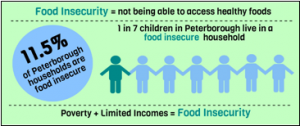
The report identifies household food insecurity as a growing issue in Peterborough City and County. Food insecurity research shows that 11.5% of households in the City and County of Peterborough are food insecure, an increase from the 10% reported in 2013. In 2011, 26% of households (including 48% of rental households) in Peterborough paid at least 30% of their income on housing (Statistics Canada, 2014). Because of insufficient affordable housing and low average wages, renters earning the average Peterborough wage of $18/hour had to work longer than in any other Canadian city to cover the average rent for a two-bedroom apartment.

“When people are forced to choose between food and shelter, housing is often paid for first, leaving families hungry at the end of the month,” noted Dr. Rosana Pellizzari, Medical Officer of Health and Chair of the Peterborough Food Action Network. “Clearly, the common denominator between the issues of food access and housing insecurity is insufficient income to make ends meet”.

The report concludes that all levels of government need to take the issue of income security much more seriously. It is time to take action on Living Wage and social assistance rates, and explore the potential of a Basic Income Guarantee.

Download the report [pdf 949 KB]

For further information, please contact:

Brittany Cadence
Communications Supervisor
705-743-1000, ext. 391
bcadence@pcchu.ca

Dr. Peter Andrée
Carleton University
613-520-2600, ext. 1953
Peter.Andree@carleton.ca