The first 7 food hub reports from Southern Ontario are now available! The team members who have worked on these case studies are Erin Nelson, Alison Blay-Palmer, Karen Landman, Elena Christy, Erin Pratley, Lori Stahlbrand and Cassie Wever. More reports from Southern Ontario will be coming soon, along with a regional summary of the exciting food hub developments in the area.
Author Archives: Phil
Are food banks an effective response to addressing food insecurity and poverty?
Guest blog from Kathy Dobson
When food banks started in Canada as an emergency and temporary measure in response to the economic recession in the 80s, they were intended to provide relief from immediate hunger as an emergency food source, not address food insecurity or poverty. Yet these so-called ‘temporary’ food charity providers are on the increase in Canada.
A panel discussion surrounding issues of poverty and food insecurity, ‘From Hunger to Health’ was recently held in Ottawa, as part of the second annual Spur festival. The discussion explored some of the root causes – and potential solutions – to the 75,000 people in Ottawa who go hungry each day.
Panel member Dr. Elaine Power, an associate professor in the School of Kinesiology & Health Studies at Queen’s University, said outright that Food banks aren’t working. “Only 20 to 30 percent of food insecure households ever go to food banks.” One of the problems with food banks, explained Power, is that they provide a comforting illusion of people not being hungry.
“Food banks show that we care,” said Power, “but they have never gone away, though they were never intended to be permanent.” The danger, said Power, is that food banks can give us a false sense of having dealt with the issue of hungry Canadians. “We forget about hunger because we think food banks are solving the problem.”
Moderator Karen Secord, manager of Parkdale Food Centre in Ottawa, said food banks are always going to be needed, though, including the 29 in Ottawa alone, until we finally solve the issue of poverty in Canada. “If people don’t have an income,” said Secord, “then the need for food banks is going to continue.”
However, not everyone on the panel seemed to recognize and acknowledge the full extent and real threat of going hungry in Canada.
Panelist Dr. Pierre Desrochers, an associate professor of geography at the University of Toronto, claimed that poverty has not only decreased over the past few generations, he also suggested what he seemed to view as an obvious and simple solution to poverty in Canada.
“In my opinion the best anti-poverty issue is a job,” said Desrochers. “We should focus on programs of job creation and build from there.”
Despite some murmurs of surprise and disapproval from several members of the audience in response to Desrochers’s ‘best anti-poverty’ solution, he continued on, claiming that, “Humanity has done more to lift people out of poverty in the last generation than ever before,” and that it used to be “historically that it was the king and a few people who could afford a decent meal.” In addition to job creation, Desrochers also suggested lowering the price of food would make it more easily available to those in need.
Power received an enthusiastic round of applause when she countered with, “The issue for the millions of people in this country is not the price of food, it’s not having enough money.”

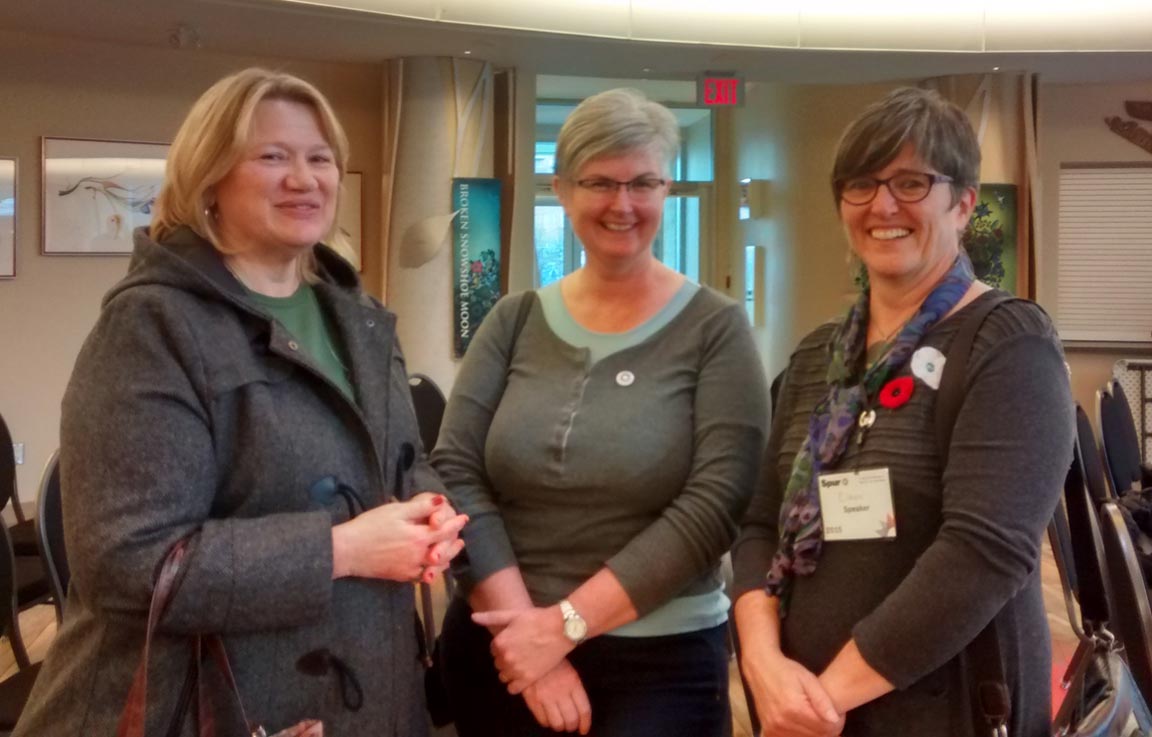
Kathy Dobson (left) in conversation with Elaine Power (right) and another attendee at the Hunger to Health event in Ottawa
“There is dignity in being able to chose the food you eat and what to feed your family,” added panel member Kaitrin Doll, an anti-poverty community engagement worker at the Coalition of Community Health and Resource Centres.
In addition to dignity, regular access to nutritional food is also an important health issue. Powers said food insecurity is a leading cause of significantly increased health care costs as well. “The poorer you are, the shorter your life, the unhealthier you are. Poor people die sooner than wealthier people.”
Power said she has a dream for Canada.
“One where we value the common humanity of all and ensure that everyone has what they need to live a socially acceptable life,” said Power. “Right now we don’t have that.”
Kathy Dobson is a journalist, author, and a doctoral student in the Communication Studies program at Carleton University. You can learn more about her work at http://kathydobson.ca/
Resistance
Film Screening and Panel Discussion
November 18, 4:45-7pm, at Mount Sinai Hospital, Toronto
Antibiotics were first massed-produced in the 1940s and their ability to fight and kill bacteria revolutionized medicine and profoundly impacted everything from agriculture to war. After less than 80 years, however, these miracle drugs are failing. Resistant infections kill hundreds of thousands of people around the world each year and there are now dozens of so-called Superbugs each with its own challenges and costs. How did this happen? Using microscopic footage, harrowing personal stories, and expert insights RESISTANCE clarifies the problem of antibiotic resistance, how we got to this point, and what we can do to turn the tide.
The MSH/UHN Antimicrobial Stewardship Program is hosting a documentary screening and panel discussion around the movie Resistance, on November 18, 2015, as part of Antibiotic Awareness Week 2015. Read more or register…
Hungry for Change
The final report of the year-long Fabian Commission on Food and Poverty sets out how a fairer food system can be built that works better for people on low incomes.
Drawing on public hearings, expert testimony and the insights of people with experience of managing poverty, the Commission has uncovered a crisis of food access for many households in the UK. There are multiple cases of parents – usually mothers – going hungry to feed their children or having to prioritise calories over nutrients to afford their weekly food shop. Many people are feeling a deep sense of anxiety from the struggle to manage serious squeezes in household budgets that arises from the cost of living rising faster than income.
… from the preface by Geoff Tansey, Chair of the Fabian Commission on Food and Poverty…
We named this independent inquiry the Fabian Commission on Food and Poverty in order to broaden the debate on the connection between these two issues in the UK. People on low incomes in the UK face a new struggle to acquire sufficient quantities and adequate qualities of food. Many people are caught between the pincers of rising food prices, household bills and housing costs on one side and stagnant incomes on the other. Something has to give for these families and the only thing to squeeze is spending on food.
Recent discussion of food and poverty has been too narrow, focusing on the growth of charitable food provision, such as food banks, and the role it plays in feeding hungry people. But charitable food provision is the tip of the iceberg – the links between food and poverty extend far beyond food banks. Critically, we need to recognise that food banks and charitable food providers are not solutions to household food insecurity, they are symptoms of society’s failure to ensure everybody is sustainably well-fed.
Download the full report [pdf]
Strong #EatThinkVote campaign points to need for Canadian Food Policy Council
… from The Hill Times online, Wed Nov. 4, 2015
By Peter Andrée
Food issues are cross-cutting and complex. Who better to deliberate on them than a council that brings together the best minds from the relevant levels of government, industry, and civil society? A food policy council would consist of stakeholders and representatives from all parts of the food system.
In the recent election campaign, we saw a new player exerting its political muscle on the Canadian food and agricultural scene. Food Secure Canada’s #EatThinkVote campaign brought to the fore the issues of poverty-related food insecurity, the obstacles facing new farmers, and the challenges in accessing safe and affordable food faced by northern indigenous communities. The campaign represents a growing alignment of actors who are connecting around issues across the policy silos of health, agriculture, trade, environment, and more.
Read more…
The Future of Food is Local
By Julie Bourassa, CFICE Volunteer
Food sustainability and climate change are increasingly urgent and intertwined issues. From the way we produce and package our food, to how much we consume, our relationship with food is not sustainable. Melissa Johnston, a Master’s student in Trent University’s Sustainability Studies program and a Research Assistant with CFICE’s Community Environmental Sustainability hub, explores a powerful solution to these issues that can be found in our very own local farmer’s markets. Read more…
Subscribe to read the latest monthly CFICE newsletter here…
Community First: Impacts of Community Engagement (CFICE), is an action research project aimed at strengthening Canadian communities by asking the question: How can community-campus partnerships be designed and implemented to maximize the value created for non-profit, community-based organizations? CFICE carries out project and research work in five areas: Poverty Reduction, Community Environmental Sustainability, Community Food Security, Knowledge Mobilization, and Violence Against Women. When it comes to community-campus relationships, we believe that together everyone achieves more.
November 2015: 30 Days of Food Systems Planning and Policy
… from Kimberley Hodgson, Chair, APA Food Systems Planning Interest Group
In November 2015, the American Planning Association (APA) will highlight and promote food systems planning and policy. In an effort to support this messaging campaign, the APA Food Systems Planning Interest Group (APA-FIG) will feature interviews with practicing planners, special blog posts, and more.
Please join the conversation! We welcome comments, images, and tweets, and encourage you to use #foodsystems when you post to various social media outlets in November. Check the APA-FIG website regularly, and follow us on LinkedIn, Facebook, Twitter (@APA_FIG, @APA_Planning), and Instagram (@foodsystemsplanning).
-
Faces of Food Systems Planning – On Monday, Wednesdays, and Fridays, APA-FIG will post a new interview with food systems planning practitioners in the public, private, and non-governmental sectors.
-
Fridays – Each Friday, APA-FIG will pose a new question on Twitter or Facebook to planners and allied professionals across North America.
-
Special Blog Posts – The APA-FIG Research, Policy, and Communication & Outreach Working Groups will explore various food systems planning and policy topics.
-
Tuesdays at APA – On November 10th, Debra Tropp, a deputy director within USDA’s Agricultural Marketing Service will discuss a recent effort to capture and quantify economic impacts of local food system investments.
-
Thanksgiving Week – During the week of Thanksgiving, APA-FIG will feature a special social media strategy to engage planners and allied professionals in a meaningful conversation about our food systems and Thanksgiving.
Creativity + Collaboration = Action
… from Katie Nolan, Agriculture and Rural Economic Development Advisor, Ontario Ministry of Agriculture, Food and Rural Affairs
Only FIVE days left to Pre-Register!
The Cities of Belleville and Quinte West, in partnership with the Ontario Ministry of Agriculture, Food and Rural Affairs, are proud to host the 5th Annual Eastern Ontario Local Food Conference on November 4 and 5.
At this year’s conference:
- Book one-on-one time with a mentor. We have experts in
- Building a food processing business
- Production of high-value crops such as hops and berries
- Small business loans
- Food safety, traceability, and regulations
- Social media
- And much more… !
- Network with potential suppliers and buyers
- Meet buyers looking for Eastern Ontario product
- Learn about how Eastern Ontario is moving the bar on local food!
For full conference details and to register: www.eastontlocalfood.ca
In addition to these great sessions and a full day of networking, delegates will be treated to a Local Food Lunch featuring locally sourced dishes. A trade show will also be a feature of the conference.
Follow us on Twitter @EOLocalFood and Facebook www.facebook.com/eastontlocalfood
See you there!
The Global Kitchen Project
…from WLU, Oct. 27, 2015
WATERLOO – Wilfrid Laurier University has launched the Global Kitchen project – a community kitchen for Laurier’s international student body that promotes the exploration of culture through food. The Global Kitchen is managed by Laurier International and located in the Harris Hope House on Laurier’s Waterloo campus.
The Global Kitchen is intended to reflect the attitude that food is an intrinsic part of one’s cultural identity and can serve as a means of understanding, experiencing, and sharing cultures. What we consume, how we acquire it, who prepares it, who is at the table, and who eats first, all reflect complex relationships and interactions among individuals and the society in which we live.
“The Global Kitchen project is a great opportunity for the community to network with Laurier students, to gain insight into the variety of cultural backgrounds at the university, and to understand and experience different cultures first hand through food,” said Peter Donahue, associate director, international student support. “The Global Kitchen Project creates an inclusive community that embraces and encourages diversity.”
The international student body will enjoy a plethora of programs at the Global Kitchen throughout the academic year, learning nutrition and culinary skills to improve their health and well being and diversify their diets. Read more…
Ontario Ag Matters
The Research and Innovation Branch will be delivering new communication products to share knowledge and successes that result from OMAFRA’s investments in research and innovation.
Our products will highlight partners’ successes, funding opportunities, events and resources and information specific to:- Agricultural and Rural Policy
- Bioeconomy – Industrial uses
- Environmental Sustainability
- Emergency Management
- Food for Health
- Products and Value Chains
- Production Systems (Plants, Animals)
- Innovation and Commercialization
- Knowledge Translation and Transfer
We invite you to sign up to receive content suited to your interests and we’re excited to share news, events and opportunities focused on Ontario agriculture, agri-food and agri-product sectors. You will only receive the above listed products if you sign up.
Please contact research.omafra@ontario.ca