Category Archives: International Lessons

Alternatives and solutions to problems or barriers to sustainable local food systems that have relevance in Ontario.

Advancing the Water-Food Nexus

TIAS-USF Webinar

Tues. Nov. 25, 2014
10-11:45 a.m. EST
16.00 – 17.45 CEST (GMT+1h)

Hosted by The Integrated Assessment Society 
and the Institute of Environmental Systems Research

The Water-Energy-Food Nexus is a relatively new approach for promoting security in all three sectors by reducing trade-offs, building synergies and improving governance across these sectors, and thus stimulating the transition to a green economy. The “nexus” is an important theme for The Integrated Assessment Society and the Institute of Environmental Systems Research since sectoral and disciplinary integration lie at the core of their mission. In order to launch the Nexus as a theme for TIAS, this webinar narrows the focus to water and food security, since the intersection of these two sectors alone is sufficiently broad and complex. It is intended for those practitioners, decision-makers and scientists whose work focuses on water security or food systems, and thus inevitably requires deeper consideration and understanding of both sectors.

The webinar will address the following questions:

  • Where are we at with the Nexus approach and what are some of the key challenges we face? What areas require strengthening and improved guidance?
  • What are some of the more promising Nexus assessment methods and tools used?
  • What kind of networking and research opportunities can we identify that will help knowledge exchange and development?

More details and webinar programme

Global Forum on Food Security and Nutrition

Street food and urban and periurban agriculture and horticulture: perspectives for a strategic coalition towards food security

Street foods in urban areas are often the most accessible means of obtaining an affordable meal for millions of consumers every day and urban and periurban agriculture can provide street food vendors with the required local, fresh, nutritious and less expensive ingredients.

Stefano Marras, sociologist at the University of Milan-Bicocca invites you to share your opinion on how we can support stronger cross linkages between food hawking and the growing of food in cities to stimulate sustainable diets and increased income. This discussion will be an opportunity to expand and strengthen the network of specialists involved in street food trade and governance worldwide. Read more


New Food Hub Management Certificate Program

The University of Vermont will launch an innovative Food Hub Management Certificate program, in January 2015. The program is a unique blend of hands-on, community-based, online and on-campus learning that will prepare students for effective management of food hubs and provide essential tools to advance their career in food systems. UVM’s Food Hub Management Certificate is offered through the College of Agriculture and Life Sciences and Continuing and Distance Education.

The program is geared toward individuals planning to create or manage a food hub, professionals with food hub experience looking to enhance their career, and food hub staff members interested in leadership development. The UVM Food Hub program was designed by the pioneers who created the first Food Hubs and a diverse team of nationally-recognized experts, including food hub practitioners, technical assistance providers who specialize in food hub development, and several members of the National Good Food Network.

For more information, visit: http://learn.uvm.edu/hubmanagement

Diversity and Sustainability of Food Systems

(Diversité et durabilité des systèmes alimentaires)

If you are in France next month, l’Institut des régions chaudes de Montpellier SupAgro will host a multi-disciplinary series of seminars on sustainable food systems from October 9 – 24. Speakers include Nicolas Bricas and Olivier de Schutter. The series is sponsored by the UNESCO Chair in Global Food Systems, Montpellier, SupAgro, member of the Laurier Centre for Sustainable Food Systems International Advisory Committee.

For more information, please contact Alison Blay-Palmer at
ablaypalmer@wlu.ca

New England Food Policy: Building a Sustainable Food System

American Farmland Trust (AFT), Conservation Law Foundation (CLF), and the Northeast Sustainable Agriculture Working Group (NESAWG) are pleased to announce the release of their new report New England Food Policy: Building a Sustainable Food System

A sustainable food and farming system in New England is key to creating a region that is resilient, just, healthy, economically vibrant, and environmentally sound. New England Food Policy: Building a Sustainable Food System identifies policies that are helping New England grow its capacity to feed itself, policies that are hindering this growth, gaps in the existing policy framework, and opportunities for new policies to strengthen our food system. Read more

Sustainable Regional Food Systems Workshop: Theory, Practice and Policy

Laurier Centre for Sustainable Food Systems

Thursday, 26 June 2014 from 9:00 AM to 5:00 PM (EDT)
Waterloo, ON

Hosted by the Laurier Centre for Sustainable Food Systems, this workshop brings together international academics, practitioners, and policy makers to share on-going research and policy initiatives. The workshop is SOLD OUT!

SCHEDULE

8:30 – 9:00 – Registration & Welcome

9:00 – 10:30

FLOWS OF PEOPLE, KNOWLEDGE & RESOURCES

Discussant: Terry Marsden, Director, Sustainable Places Research Institute, Cardiff University 

Rich Pirog, Senior Associate Director, Michigan State University, Centre for Regional Food Systems

The Michigan Good Food Charter: Using networks to create change in the food system

Juliane Brandt, Christoph Kasper and Undine Giseke, Technical University, Berlin

Urban agriculture as an integrated planning strategy – a productive green infrastructure for Casablanca

Andrew Spring, PhD Candidate, Wilfrid Laurier University, and Joe Hanlon, Sahtú Renewable Resources Board

Food security in the Sahtú Region, NWT

Charles Levkoe, Postdoctoral Fellow, Wilfrid Laurier University

The food movement in Canada: A social movement network perspective

10:30 – 10:45 – Networking Break

10:45 – 12:15

SOCIAL DIMENSIONS OF REGIONAL FOOD SYSTEMS

Discussant: Cornelia Flora, Distinguished Professor, Department of Sociology, Iowa State University

Damien Conaré, UNESCO Chair in World Food Systems, Montpellier SupAgro

Emerging linkages in global food studies: A UNESCO Chair perspective

Peter Andree and Patricia Ballamingie, Carleton University, and Carolyn Doris

Challenges at the intersection of food and housing security with fair wages for farmers

Molly Anderson, Partridge Chair in Food and Sustainable Agriculture Systems, College of the Atlantic, Bar Harbor, Maine

Fostering food security through sustainable regional food system visions

Erin Nelson and Karen Landman, University of Guelph

Alternative agri-food initiatives and social capital: Learnings from Ontario and Mexico

12:15 – 1:30 – Networking Lunch

1:30 – 2:45

ACTIVATING FOR CHANGE

Discussant: Laurette Dube, Professor, Desautels Faculty of Management, McGill University

Connie Nelson and Mirella Stroink, Lakehead University, and community partner

Crowd sourcing and sustainable food system projects

Irena Knezevic, Research Associate, Centre for Sustainable Food Systems, Su Morin and Linda Best

Innovative food initiatives in Atlantic Canada

Lori Stahlbrand, PhD Candidate, Wilfrid Laurier University

Institutional local sustainable food procurement: Building capacity

2:45 – 3:00 – Networking Break

3:00 – 4:30

SUSTAINABLE REGIONAL FOOD SYSTEMS: POLICY AND PLANNING

Discussant: Wayne Roberts, Food Policy Consultant, Retired Toronto Food Policy Council Manager

Phil Mount, Postdoctoral Fellow, Wilfrid Laurier University

Supply management and local food: Solving chicken and egg riddles

Jill Clarke, Assistant Professor, John Glenn School of Public Policy, Ohio State University

Integrating sustainable food systems into planning

Samina Raja, Associate Professor, School of Architecture and Planning, State University of New York at Buffalo

Planning for food: Insights from the Healthy Communities Lab

Jane Battersby-Lennard, African Centre for Cities, University of Cape Town

Everyone’s problem, no-one’s mandate: Working towards an urban food systems approach in Cape Town, South Africa 

4:30 – 5:00 – Closing

Participatory Plant Breeding

Join the Bean Breeding group for a talk by a visiting agronomist.

Monday June 9, 2014
9:30am
202 Crop Science Bldg., University of Guelph

Marvin Gomez is a Honduran agronomist and a leader in Participatory Plant Breeding in Central America.

For the past 10 years he has worked with the Honduran NGO, Foundation for Participatory Research with Honduran Farmers (FIPAH), which partners with local farmer researchers to develop maize and bean varieties for poor hillside farmers.  FIPAH works extensively with breeders at the Pan American Agricultural School, Zamorano, and at the International Maize and Wheat Improvement Centre (CIMMYT). FIPAH’s work is to support local farmers by training them to cross landraces with breeder materials and to provide farmers with access to unreleased breeder materials through participatory varietal selection.   Some of these farmer selected/generated materials have already been released at the national level in Honduras and others are in the pipeline for release. FIPAH, long supported by Sally Humphries, University of Guelph, is recognized in Central America as a leader in the field of participatory plant breeding by both scientists and civil society organizations alike.

The local food movement

Setting the stage for good food

From our friends at the MSU Center for Regional Food Systems:

This publication provides a brief history of the U.S. local food movement and its link to “good food” – food that is healthy, affordable, fair, and green – within the contexts of food access and health, food justice and sovereignty, the environment, and racial equity. The publication also contains a timeline that provides a sample of important U.S. events, policies, and statistics over the past 70 years that mark the growth of local food through the lens of the four elements of good food. Download the report [pdf]…

Fortnightly Feast vol. 21

This is the Local Food Election!

[…] There was lots of media hype (both positive and negative) about the passage of the Local Food Act late last year, with all parties scrambling to show how they were the most supportive of Ontario’s local food scene, farmers, food access programs, etc.

But as Sustain Ontario’s latest assessment makes clear, only pieces of the Act have been ‘proclaimed’ —and therefore legally binding.

The sections [of the Local Food Act] that have not yet been proclaimed are:
  • the creation of a tax credit for farmers who donate to community food programs and food banks
  • setting goals or targets to aspire to with respect to
– public procurement of local food
– increasing access to local food
I think this would come as a surprise to many who are active in the food access and local food scene —let alone the broader public.  See the full post here.


A New RUAF Website!

RUAF is the only global resource centre on urban agriculture with over 15 years of on-ground experience in urban and peri-urban agriculture project implementation, policy design and action-research in over 40 cities in more than 20 different countries in the world. After these 15 years of operation, we considered it timely to renew the RUAF website in order to further enhance its functionality for the continuously increasing number of users (actually close to 1 million unique visitors/year!). Check out the new site!


Beyond Honeybees: Now Wild Bees and Butterflies May Be in Trouble

Wild bees and butterflies are out on the landscape, making them difficult to count, and a lack of historical baselines makes it challenging to detect long-term trends. Slowly but surely, though, results from field studies and anecdotal reports from experts are piling up. They don’t paint a pretty picture. Many pollinator populations seem to be dwindling. Full story at Wired.


City Regions as Landscapes for People, Food and Nature

It’s time to think ‘outside the urban box’
City Regions as Landscapes for People, Food and Nature is a new take on integrated landscapes that highlights important linkages between cities, peri-urban areas and rural areas. Challenges like poverty, climate change, and growing demand for resources are issues faced across the urban rural continuum, and they all relate to food. With food and agriculture linking the ecosystems, economies, and public health of communities rural and urban, we must plan for food systems on a city region scale in order to meet 21st century challenges and reduce the risk they pose to food and nutrition security. Download the report.

Community Investments

Spring 2014: Volume 26, Number 1 (pdf 2.5 mB)
Special Focus: Collective Action for Community Development

It’s not surprising that the idea of collective action has gained rapid interest and followers recently. The framework, which seeks to produce true alignment of purpose across related sectors working on social, economic, and environmental challenges, offers a great deal of promise for making significant improvements in the life chances for disadvantaged populations.

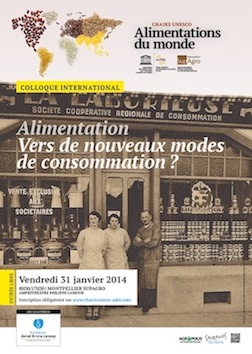
Alimentation : Vers de nouveaux modes de consommation ?

nonameL’Institut des régions chaudes, Montpellier SupAgro et la Chaire UNESCO «Alimentations du Monde» ont mis en ligne les vidéos de colloque annuel du 31 janvier dernier : “Alimentation : vers de nouveaux modes de consommation ?”


http://www.chaireunesco-adm.com/spip.php?rubrique93

La consommation alimentaire des ménages est identifiée comme un enjeu majeur en matière de durabilité, notamment pour réduire les impacts des activités humaines sur l’environnement et améliorer la santé des populations. On reconnaît également de plus en plus l’importance des comportements domestiques, après achat.


The UNESCO Chair on World Food Systems has posted the videos from the third edition of its annual conference, “Towards new patterns of consumption” (January 31st, 2014), which explored the food system at the scale of individual.

Food consumption is identified as a major challenge in terms of sustainability, including reducing the impacts of human activities on the environment and improve the health of populations. This raises the question of possible incentives (and their effectiveness) in changing food consumption patterns. What are the levers and brakes that can intervene in supporting practice changes? What is its acceptability by consumers? What types of alternative models participate in change?

http://www.chaireunesco-adm.com/spip.php?rubrique93