Laurier local food researcher named national award finalist

WATERLOO – Laurier professor Alison Blay-Palmer has been named finalist for the Social Sciences and Humanities Research Council of Canada’s (SSHRC) 2013 Impact Partnership Award, demonstrating Waterloo Region’s commitment to highlighting the importance of local foods and local farming. The winner will be announced October 15 at the World Social Science Forum in Montreal.

For more than a decade, Blay-Palmer has been involved in research related to sustainable food systems. Blay-Palmer’s SSHRC-funded research partnership, “Building and Reinforcing Resilient Food Networks in Canada and Beyond” involves Carleton University, University of Guelph, Lakehead University, Ryerson University, local food networks in Ontario, across Canada, and extends into the international community. The partnership has produced a widely respected report, “Ontario Communities of Food: Models and Best Practices” and a community food toolkit. The tool kit is being used by communities around the world and has been a catalyst for extending Blay-Palmer’s partnerships globally.

“The continued growth of Dr. Blay-Palmer’s partnerships, both locally and internationally, is a testament to how deeply this work addresses the critical food security issues facing Canadians,” said Abby Goodrum, Laurier’s vice-president: research. “’Building and Reinforcing Resilient Regional Food Networks in Canada and Beyond’ is a superb example of what can be accomplished through academic and community partnerships. The partnership has broadened the conversation around food security, engaged Ontario Premier Kathleen Wynne, and reached out to include provincial and international partnerships.”

Blay-Palmer’s research is based on community-linked research meetings, participatory research projects, workshops, reports, peer-reviewed journal papers and conference presentations. Her sustainable food partnership has been credited with having a significant impact on Canada’s food security. Blay-Palmer’s dedication to local food was recognized in the Ontario Legislature during the second reading debate of the proposed Local Food Act, introduced by Premier Wynne, who also serves as the Minister of Agriculture.

Blay-Palmer is director of the recently established Laurier Centre for Sustainable Food Systems. “We are very excited about the work of the research centre,” said Blay-Palmer. “Local and sustainable community food initiatives reflect a growing public awareness that food can act as a vehicle for positive change. The SSHRC award nomination recognizes our continuing work to be at the forefront of research on these initiatives.”

The Partnership Award acknowledges a SSHRC‑funded formal partnership for its outstanding achievement in advancing research, research training or outreach. It is awarded to a partnership that, through mutual co‑operation and shared intellectual leadership and resources, has demonstrated impact and influence within and beyond the research community.


Laurier Centre for Sustainable Food Systems: wlu.ca/research/food

Nourishing Communities: Sustainable Local Food Systems Research Group: nourishingontario.ca

Community Food Toolkit: http://nourishingontario.ca/community-food-toolkit/

“Models and Best Practices for Building Sustainable Food Systems in Ontario and Beyond”: http://nourishingontario.ca/models-and-best-practices/

“Impact Awards:  SSHRC reveals shortlist:” http://www.sshrc-crsh.gc.ca/news_room-salle_de_presse/latest_news-nouvelles_recentes/impact_awards_2013-prix_impacts_2013-eng.aspx
Upcoming Webinar

Farmers’ Markets in Low-Income Communities: Strategies & Best Practices

Thursday, August 29
11:00 a.m. – 12:00 p.m. Pacific / 2:00 p.m. – 3:00 p.m. Eastern

Across the continent, healthy food stakeholders are working to support farmers’ markets that increase access to healthy foods in low-income communities.  This webinar will discuss how incentive programs, retail strategies and policies are changing how consumers shop at farmers’ markets in their neighborhoods. Experts will share best practices and lessons learned from the field about how to implement programs to promote the sale of healthy food at these retail outlets.

Register here.

Lakehead University Tier II Canada Research Chair in Food Systems Studies

Lakehead University invites applications for a Social Sciences and Humanities Research Council (SSHRC) Tier II Canada Research Chair (CRC) in Food Systems Studies at a rank commensurate with experience and qualifications. We seek an innovative, outstanding emerging researcher that has demonstrated interdisciplinary research strengths, grantsmanship and publications in food systems study.  The Chair will work closely with colleagues in the Faculty of Health and Behavioural Sciences and will take a lead role at the Food Security Research Network (FSRN) (www.fsrn.ca ) which has an established track record in community-based research.  There are many opportunities for the Chair to embrace a diversity of interdisciplinary topics critical to the study of building resilient and sustainable food systems.  Ongoing research at FSRN embraces the application of a complex adaptive systems perspective to food systems.  Given the scope and potential impacts of local food systems, it is particularly critical to understand their dynamics as they emerge through innovation and evolve in response to their surroundings within a context geared primarily toward the dominant agri-industrial system.

See the full posting for application details. Persons that are interested may contact Dr. Mirella Stroink  mstroink@lakeheadu.ca or Dr. Connie Nelson cnelson@lakeheadu.ca for further information on this Chair position.  Selection decisions will be made by Lakehead’s CRC Committee.

Fortnightly Feast – vol. 12

Focus on Urban Agriculture

Urban and Peri-Urban Agriculture for Resilient City-Regional Food Systems
Marielle Dubbeling’s post on the Landscape blog, about the role that urban and peri-urban agriculture can play in enhancing the sustainability and resilience of urban food systems. Read more

The Sustainable Food Cities Network
From its evolution as an event organised by the Soil Association and Cardiff University and hosted by Bristol City Council in 2011, the Sustainable Food Cities Network has become an alliance of public, private and third sector organisations that believe in the power of food as a vehicle for driving positive change. Read more

New Agriculturalist Focus on… Urban Agriculture
Urban agriculture is being increasingly recognised as an important strategy to respond to a number of key challenges – including poverty, food security and nutrition, unemployment and the management of wastes and wastewater. Read more

Food Hub Movement Gaining Momentum Across Michigan
While the creation of a food hub in your community may seem like a no-brainer, they require careful planning and an investment from all of the stakeholders in the local food system. Read more

And in the category of coolest name ever, in Cowpens, SC: Thicketty Mountain Farms!

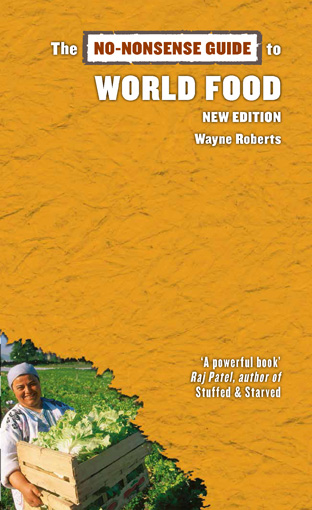
The No Nonsense Guide to World Food – Wayne Roberts

No-nonsense GuideIt’s not a worm’s eye view of the food world, but then it’s not a bird’s eye view either. The brand new and totally rewritten edition of the No Nonsense Guide to World Food is written by Wayne Roberts, longtime manager of the Toronto Food Policy Council, who sees the world from between the blades of a grassroots movement, mainly in Ontario, where he’s lived most of his life. Friendly and down-to-earth.

The book is designed as an intro, which means it’s easy to read rather than technical,  and fairly short rather than fairly long. Each of the six chapters asks and answers a different question, so a moment’s glance shows that you’ll get up-to-date info on the meaning of food system, industrial agriculture, junk food, hunger, food security, food sovereignty, industrial agriculture, and sustainable food strategy.  It has the earmarks of having been designed with a university intro course on food in mind.
For copies or more info on The No Nonsense Guide to World Food, go to the website of Between the Lines.

Ontario’s Environmental Farm Plan and Consumer Sustainability Demands

Guest Blog from Ralph Martin,
Professor and Loblaw Chair, Sustainable Food Production
Department of Plant Agriculture, University of Guelph

Consumers are increasingly asking for more information, not only about location of food production, but also about how food is grown on a given farm. It can be difficult for food processors and retailers to verify that food has been sustainably produced. However, farmers who are busy with current management details are not keen to add more record keeping and verification protocols to their to-do list. Nevertheless, many farmers in Ontario are already engaged in the Environmental Farm Plan (EFP) and there are opportunities for the EFP to help them show processors and retailers what they are doing. Although the EFP has not been audited by a third party, there are opportunities for it to be upgraded and audited for farmers that determine it will be cost effective for them to pay for such a service to establish market differentiation of their products. The EFP is well known and voluntarily applied on farms in Ontario, unlike more rigorous verification programs in other countries that have very low adoption rates.

For more details, see Potential Role of the Ontario Environmental Farm Plan in Responding to Sustainability Demands of the Agri-food Supply Chain, by Claudia Schmidt, Janalee Sweetland and Al Mussell of the George Morris Centre.  [1.6 MB pdf]

Sustain Ontario Upcoming Flocking Options Webinar: Supply Management 101

On Thursday, August 1st at 12 Noon (EDT) Sustain Ontario will be hosting an exciting new webinar in support of their ongoing Flocking Options campaign. Leading this thought-provoking presentation will be Christie Young, the Executive Director of FarmStart and Anne Freeman of the Greenbelt Farmers’ Market Network. Read more

Fortnightly Feast – vol. 11

For the faithful reader of this post, and those interested in the creation of sustainable regional food systems, here are two wonderful sources of news, information and events:

Locavore News

The Locavore News Editor, Elbert van Donkersgoed, puts together concise but informative summaries with links to only the most interesting and relevant stories about local food on the internet. These stories are carefully separated into three separate weekly posts, with  Ontario-based, Canadian and international versions. Information about Locavore News is available on the Terra Coeur website. This includes an archive of past issues of Locavore News.  To add your address to the Locavore News distribution list, send an email to: Plumbline-subscribe@terracoeur.com.

Sustain Ontario

Along with a huge amount of information on their policiespolicy papers, consultations and campaigns, Sustain Ontario also has three streams of food news: from SO, from their member organizations, and from around the world. You can also subscribe to have Good Food Bites sent to you every Wednesday, or to receive monthly updates about the work of the Alliance and opportunities to support food and farming in Ontario.


6 US Regional FOOD HUB models

Seems to be all food hubs, all the time – particularly south of the border, where state and local planning and economic development efforts appear to be following the lead of the USDA in advocating the value of these regional food hubs:

NC   Are Food Hubs the Key to Expanding Regional Food Systems?

WI   Wisconsin Food Hub Cooperative and institutional procurement