Author Archives: Phil

About Phil

Research Associate, Nourishing Ontario

Social economy in a Globalized World

Guest blog from Irena Knezevic, Assistant Professor, Communication, Carleton University

CIRIEC international research conference on social economy

July 2015, Lisbon, Portugal

International Center of Research and Information on the Public, Social and Cooperative Economy (CIRIEC) organizes a bi-annual research conference focusing on social economy, which by their definition includes cooperatives, mutual societies, foundations, and cultural and philanthropic organizations. This was its fifth conference and over 300 people from around the world were in attendance. Portugal was an appropriate setting for this gathering as the country boasts a vibrant social economy sector and in 2013 it adopted its General Law on Social Economy, following the example of Spain that similarly cemented social economy into its legislative framework in 2011.

This year’s theme was “Social economy in a Globalized World” and consequently many of the sessions focused on issues of globalization, financialization, governance, territories, and the social economy’s relationship to the state. In many ways it was a celebration of the contributions that the sector makes (and can potentially make) to social well-being in a world where economic inequalities are on the rise and the neoliberal economic model is failing.

A number of presentations relied on traditional economic theory to provide very abstract assessments and projections related to social economy. Others reported on very regionally specific trends. Nevertheless, several presentations offered some interesting intersections to our own work. Nathalie Verceles from the Philippines used her fieldwork with indigenous women’s cooperatives to illustrate how the social and informal sectors have been historically undervalued precisely because they typically employ those who are already socially marginalized. Alex Murdock from the United Kingdom described his work with social enterprises to develop measurements of social return on investment, something our community partners have already identified as a pressing need here in Canada. Jutta Gutberlet from the University of Victoria, BC, shared her research on participatory sustainable waste management in Brazil where informal recyclers’ networks formalized into cooperatives to develop enterprises focused on social inclusion, empowerment and collective action.

While generally an enthusiastic gathering, the conference was not without its critics. The purpose of the conference was to “[encourage] interdisciplinary dialogue, exchange and collaboration in order to enhance the contributions and applications of scientific inquiry for understanding and improving the life conditions and experiences of the less favoured people.”

CIRIECWhile the diversity of the participants was notable, the organizational leadership and keynote speakers were much more monolithic. The opening night and the second day’s plenary session included a total of twenty speakers. Only two of them were women (and one of them was not even on the original schedule but spoke in place of a participant who was unable to attend). The rhetoric of inclusion was thus not very well reflected in the voices that were featured. This, however, did allow for very lively coffee-break discussions among participants, suggesting that this imbalance was far from unnoticed.

Despite this shortcoming, the general tone of the conference was that of certainty that social economy can bring about prosperity and equity much more effectively than the neoliberal model ever could. That potential, many of the participants suggested, is what will make social economy blossom in the coming years. You can find more information about CIRIEC here. Or visit the conference website where you can find the complete conference program.
Localized Agri-food Systems: Challenges for the new rurality in a changing world

7th International Conference on Localized Agri-food Systems

During the last decades, Localized agri-food systems (SYAL) have become increasingly important as tools for farmers, rural firms and consumers to meet market challenges and satisfy the rising demand for “food with a farmers face”. The potential contribution of localized agri-food systems to rural development by promoting economic development, social cohesion and counter-acting the demographic impact of agricultural modernization has also increased their political relevance.

The European Research Group SYAL and Södertörn University welcomes you to the 7th biannual world conference on localized agri-food systems. The congress will be organized by Södertörn University and ERG SYAL, and held in Stockholm the 8-10 of May 2016. For more details

A Day full of Promise for Ontario’s Small-Flock Growers and Supply Management Programs

(Artisanal Chicken Ranch, Part I)

After years of pressure from independent small-flock chicken farmers, as well as from NFU, PFO, Sustain Ontario, and Eat Local Sudbury, and after province-wide consultations on what to do with new growth opportunities, Chicken Farmers of Ontario has crafted a potentially marvellous new Artisanal Chicken Policy (pdf 276 kB), and released it yesterday.

CFO to grow local food communities with new ‘Artisanal Chicken’ program launch

BURLINGTON, ON – July 28, 2015 – Chicken Farmers of Ontario (CFO) has announced a portfolio of new programs that will support expanded business opportunities for chicken farmers and offer Ontario consumers even more choice in accessing locally grown, high quality chicken. The new business opportunities were developed following the recent farmer, public and industry ‘Allocating Growth’ consultations, and includes an ‘Artisanal Chicken’ program which will appeal to smaller, independent, family farmers looking to meet local markets. Read more

This means the former Small Flock Exemption policy —which remains at 300— is now the Family Food Program, language that will more clearly align with the intent of the exemption: on-farm consumption or farm-gate sales.

The Artisanal Chicken Program on the other hand “…is directed at those farmers who are interested in growing between 600 and 3,000 chickens annually for select target markets such as local farmer markets.”

The closing date for submissions for 2016 Applications is September 4, 2015.

CFO will also be creating a quota-based Local Niche Markets program for those wishing to graduate from the Artisinal Program “to support those larger niche or regional markets of 6,000 chickens or more per year”.

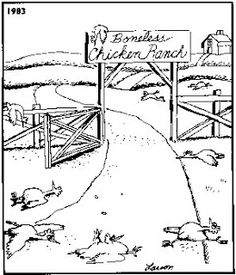
Gary Larson, 1983… And as with any such program, the devil will be in the details. There are already questions about the fine print—like how will “traditional methods” fly with On-Farm Food Safety Assurance and Animal Care Programs, to provide mutually acceptable, appropriate and complementary levels of on-farm safety, security and viability?

The dust has yet to settle on this newly released policy. Hopefully, we will have some answers to relay in Artisanal Chicken Ranch Part II…

Global Challenges and Rural Responses

Probably the best rural geography conference in Wales

(C’mon, it’s Cymru!)

Guest blog from Phil Mount, Postdoctoral Fellow, Laurier Centre for Sustainable Food Systems

I recently attended Global Challenges and Rural Responses, the 8th Quadrennial UK-US-Canadian Rural Geography Conference in Wales, 6th – 12th July 2015 — co-sponsored by Aberystwyth and Swansea Universities.

aberglade

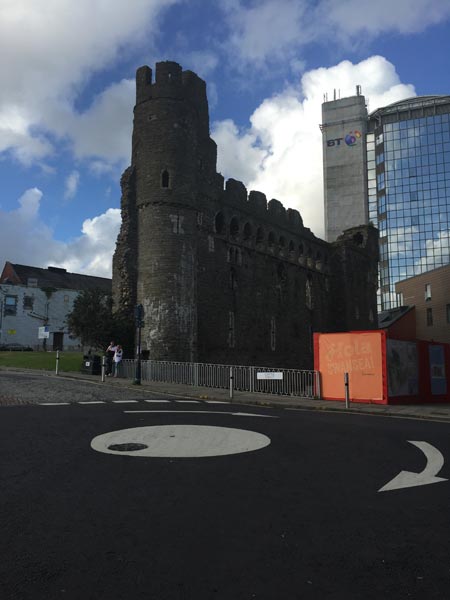
Swansea-castle


This conference brings together the AAG Rural Geography Specialty Group, the CAG Rural Geography Study Group and the RGS-IBG Rural Geography Research Group in an intense, intimate, engaged format, wherein each of the 33 delegates shares their research with the other 32, in sessions that span a week. Presentations are carefully interspersed with field trips highlighting local rural issues—including the dangers of jogging on increasingly congested Welsh roads…

Keith

Navigating a Gower traffic jam (photo courtesy Doug Ramsey)

… and evenings capped with copious quantities of socializing.

Group-photo

Enjoying an Y Consti-tutional (photo courtesy Michael Woods)

Themes spanned the transdisciplinary practice of rural geography; the changing nature of rural environmental challenges;

welshpower

… the new face[s] of exurban development and rural landscapes; the realities of modern farming; the role of alternative food networks and changing practices in shaping the new rural realities; rural responses to global challenges…

John-Smithers-brutal-croquet

(photo courtesy Lisa Harrington)

… and rural gentrification; re-imagining and rebuilding rural communities and rural-urban connections; and understanding the implications of global economic restructuring and collaborative responses in rural communities.

traffic

Collaborative responses (photo courtesy Colleen Hiner)

My own research, ‘Scale and the conventionalization of local food’, found many points of interconnection with a series of presentations that mapped the implications of food systems transitions for rural and urban communities, through both local and global food chains. These presentations covered diverse locales—from the South Carolina Lowcountry to Riga, rural Kenya and Hong Kong—as well as diverse subjects, including civic and political engagement, the influence of a legacy of exploitation, political agroecology, cultural firewalls, agriburbia, and measuring the performance of global and local food chains.

global-food

Sampling Welsh-Indian fusion at Patti Raj, Swansea (photo courtesy Colleen Hiner)

For me, many of the conference isights coalesced around the diversity of responses in rural regions and landscapes to global realignments, state-level austerity and delegation of services, combined with a growing distortion from wealthy rural amenity investors.

nags

…expressing deep concern for the rural horse-racing industry… (photo courtesy Michael Woods)

Over the course of the week, it became clear that rural geography methodologies are well-positioned to incorporate metrics that recognize complexity, and participatory methodologies that recognize rural positionality;

Gower-Inn-hydration

… to investigate land use policy and struggles;

Doug-Ramsey

North Brandon getting the sharp end of the stick… again (photo courtesy Michael Woods)

… to rethink the rural, and rural globalization; to explore governance of rural countryside, environment and community; and to explain the global challenges and rural responses reflected in uneven development, the construction of rural life, and crossing boundaries.

Newtown-twins

(photo courtesy William Wetherholt)

The conference highlights also included the many forays into the Welsh countryside:

hike2

Three Cliffs Bay (photo courtesy Randall Wilson)

Parkmill, Gower (the UK’s first Area of Outstanding Natural Beauty) and Three Cliffs Bay;

glance

greengreenhills2the National Wool Museum, Llandysul, demonstrating the historical and reviving importance of artisanal wool production to the Welsh countryside;

catup

Centre for Alternative Technology, Llwyngwern Quarry, Pantperthog, Machynlleth

… the Centre for Alternative Technology (CAT), with alternative energy and construction displays—including wind, solar, hydro, wood pellets, green roofs, straw bale, packed earth and much, much more;

Frolicking-geographers-Newtown

(photo courtesy Lisa Harrington)

… and Newtown—where stoic field researchers navigated an incredibly serious interactive walk while reflecting on everyday globalization in a small town, using Storymap. And carefully measured the accuracy of random peri-urban birds. Seriously.

It is often difficult to estimate the value that comes from sharing academic work in a conference setting, but i have no doubt that the strength of the bonds created while discussing our work and its implications, across diverse rural Welsh landscapes—and over the occasional pint of Welsh conviviality—will continue to generate fruitful collaboration and useful comparative work on issues that face rural communities, globally, for years to come.

And perhaps a tri-nation croquet grudge match.

Croquet-conversation

(photo courtesy William Wetherholt)

Our Common Future Under Climate Change

Guest blog from Byomkesh Talukder, PhD candidate in Geography and Environmental Studies, Wilfrid Laurier University

In “Our Common Future Under Climate Change” International Scientific Conference, 7-10 July 2015 Paris, France, the scientific community from around the world came together to address key issues concerning climate change in the broader context of global change. The conference offered an opportunity to discuss solutions for both mitigation and adaptation issues, as well as many side events organized by different stakeholders. In the conference, delegates discussed—among many other scientific and social issues—sustainable local communities, sustainable food and agricultural systems, and climate smart agriculture as part of local adaptation and social learning for a transformative low carbon society.

11741007_864693063567675_1859881012927374554_o

As one of the doctoral students of Professor Alison Blay-Palmer, I represented and promoted the philosophical views of the Laurier Centre for Sustainable Food Systems, and presented a paper in the conference in UNESCO entitled “Multi-Criteria Decision Analysis (MCDA) Technique a Tool for Assessing and Comparing Sustainability of Climate Smart and Conventional Agricultural Systems”. During the conference, I also came in contact with many world famous academicians, experts and dignitaries, and had the opportunity to exchange views with Nobel Laureate Joseph Stiglitz.

Ontario Food Hub Case Studies

Food hubs are actual or virtual spaces through which food is collected and distributed to processors, retailers, restaurants, or other organizations. They can also provide space for other food-related activities including food preparation, handling and/or processing, education and skill-building, and increasing food access.

With generous funding from the Ontario Ministry of Agriculture, Food, and Rural Affairs, the Nourishing Communities research group has recently completed a series of in-depth case studies of food hubs in Ontario. These case studies tell the stories of innovative food hubs from across the province, and provide insights into what makes a food hub successful, and how these businesses and organizations help build more sustainable, local food systems.

In Northern Ontario, the food hub case study work was led by Dr. Connie Nelson and her team at Lakehead University. Here is a look at what they found.

Reports from Eastern and Southcentral Ontario will be coming soon!

Ontario’s Local Food Report: 2014-15 Edition

The Local Food Strategy is one of the key ways government and industry are working together to solidify Ontario’s position as a world leader in food production.

A major component of the strategy is the Local Food Act, 2013, which provides new tools to increase awareness of local food, nurture local food markets and foster vibrant food-based economies across the province. A key feature of the act is the establishment of goals or targets. The first series of goals – for food literacy – were announced in January 2015. By setting these goals and committing to measure progress, we are working to enable more Ontarians to identify, obtain and prepare food grown in our Ontario.

The Local Food Act, 2013 calls for an annual report on the government’s local food activities. This publication marks our first annual Local Food Report. It provides the groundwork for future reports that will chart our progress in bringing local food to more tables across the province.

Read the full report here


Barn doors open for local food

from the Edmonton Sun, Sunday July 12, 2015

Agriculture is Alberta’s largest renewable industry, with more than 43,000 farms on 50.5 million acres of land exporting over $9 billion in products and produce every year. That being said, Alberta is also the most urbanized province in Canada, with over 80% of the population living in cities.

Travis Kennedy, the urban farmer in charge of the Northlands Urban Farm at the corner of 113 Avenue and 79 Street, said participating in Alberta Open Farm Days is a great way for people to learn where their food comes from. Read more

Urban food policies : markets, catering, urban/rural connexions

International meeting between urban governments, researchers and development stakeholders

An international meeting dedicated to sharing knowledge and practices among local governments of cities and urban regions from sub-Saharan Africa, North Africa, the Middle East, Asia and Latin America, along with research and development actors…

Beyond urban agriculture… the conference will explore three strategic levers that city and urban region governments can mobilize : markets infrastructure and logistics (wholesale, retail, transportation, etc. ); catering services (school, popular restaurants, street food, etc.); the new forms of connexions between urban and rural areas (twinning, urban investment in agriculture, etc.)…

This conference is organized by the UNESCO Chair on world food systems and the French research center CIRAD  together with the French Agency for Development – AFD, the FAO – Food for the cities program, the RUAF Foundation, the Regions United Organisation (ORU- Fogar),  the Mercadis, Agropolis Fondation and the Charles Léopold Mayer Foundation for the Progress of Humankind (FPH).

Read more

Scaling Up

The Convergence of Social Economy and Sustainability

When citizens take collaborative action to meet the needs of their community, they are participating in the social economy. Co-operatives, community-based social services, local non-profit organizations, and charitable foundations are all examples of social economies that emphasize mutual benefit rather than the accumulation of profit. While such groups often participate in market-based activities to achieve their goals, they also pose an alternative to the capitalist market economy. Contributors to Scaling Up investigated innovative social economies in British Columbia and Alberta and discovered that achieving a social good through collective, grassroots enterprise resulted in a sustainable way of satisfying human needs that was also, by extension, environmentally responsible.

Read more