Author Archives: Phil

About Phil

Research Associate, Nourishing Ontario

The Brazil Food Guide: Look at food differently in 2015

Analysis from Wayne Roberts in Rabble.ca

… Despite the insipid title, Dietary Guideline for the Brazilian Population, this is unquestionably the most down-to-earth yet visionary rethink of food’s role in health promotion since national food guides were introduced during World War II, one of the rare times in history when the physical stamina of munitions workers and soldiers  captured the attention of national governments.

… The preliminary scientific thinking behind Brazil’s guidelines come from a partnership between Carlos Monteiro and Geoffrey Cannon, who published a lengthy series of articles in the magazine World Nutrition culminating in the 2012 publication of a commentary on “ultra-processing” as “the big issue for nutrition, disease, health, well-being.”

The argument there provides the key thread linking the 150 pages of the Brazilian health ministry guidelines, which is a new classification system based on levels of processing, not food groups.  Read more

Building a Food Strategy for Wellington and Guelph

From Phil Mount and Ashley McInnes, Co-Chairs of the Guelph-Wellington Food Round Table:

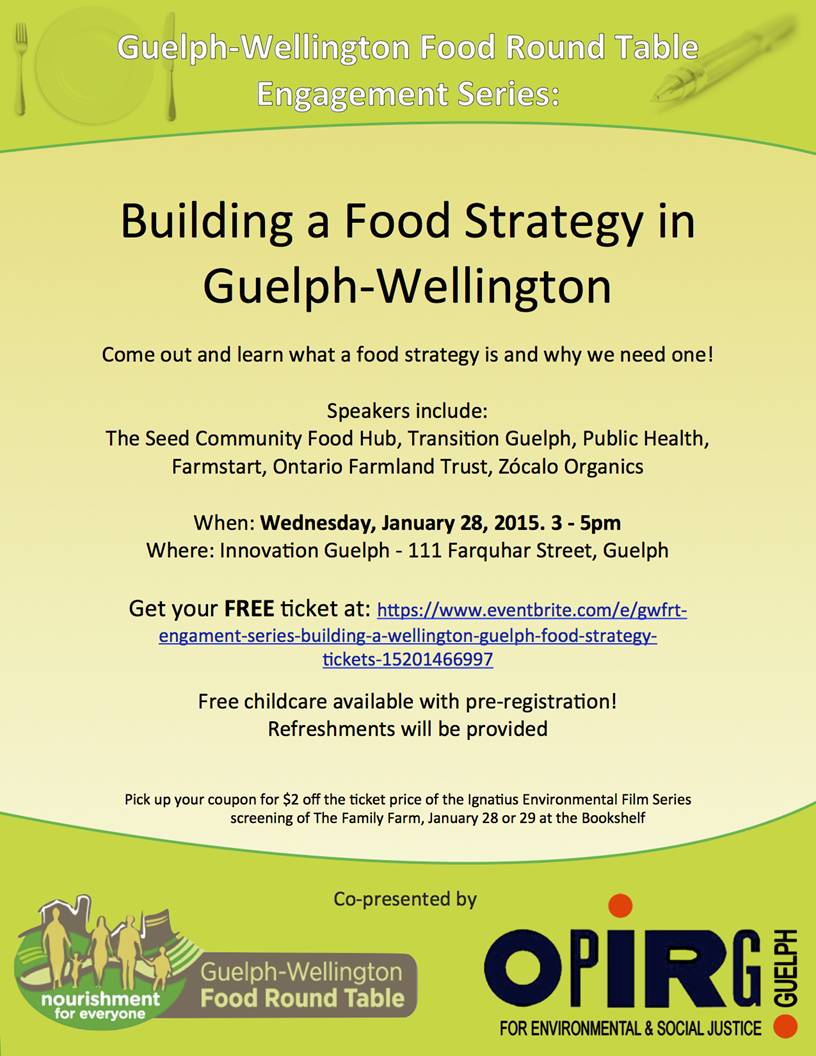
The Guelph-Wellington Food Round Table (GWFRT) and Ontario Public Interest Research Group-Guelph (OPIRG) invite you to the first in a series of events focusing on a Food Strategy for Wellington County and Guelph. Join us for this free event, to help determine our regional food policy, investment and development priorities with a diverse group of stakeholders—including public officials, community organizations, farmers, restaurateurs and engaged citizens—as we begin the process of developing a community-led Food Strategy for Wellington County and Guelph.

In a rapid-fire format, a handful of presenters will answer the challenge question “Why do we need a regional food strategy?” — including speakers from FarmStartThe Seed Community Food HubWellington-Dufferin-Guelph Public HealthTransition GuelphOntario Farmland Trust and Zócalo Organics.

Free childcare is available with registration. Refreshments will be provided. Pick up your coupon for $2 off the ticket price of the Ignatius Ecology Film Series screening of The Family Farm, January 28 or 29 at the Bookshelf!

Further events in the GWFRT Food Strategy Engagement Series — Erin (February 13) and Centre Wellington (3rd week of March)—  will include a free screening of The Family Farm.

Please visit the link below to register, to read a food strategy description, and for more information about the event. Limited space available.

https://www.eventbrite.ca/e/gwfrt-engagement-series-building-a-wellington-guelph-food-strategy-tickets-15201466997

food strategy

Food Strategy Poster [pdf 367 kb]

Kitchen Table Talk: Local food dialogues

What could be more important than feeding ourselves daily? Do you ever wonder how food is grown in the farmlands around you? Perhaps you’re wondering what it means to be ‘organic’ and how you can afford it? What does it mean to be sustainable? Are genetically modified foods good for us and the environment that supports us? How do you save your own seeds?

KIM FELLOWS (Sunday January 18th, 2015) 1:30pm at Kitchener Public Library, Meeting Room A

Title of Talk: The World of Pollinators: What’s the Buzz?
Description of Talk: Why should we care about buzzing insects? Kim will draw you into the world of pollination and how it relates to issues of food security.

DR. RALPH MARTIN (Sunday January 25th, 2015) 1:30pm at THEMUSEUM

Title of Talk: The Dynamic of Responsible Consumption and Sustaining Food Production

Description of Talk: Food production capacity depends on healthy soil, clean air and water, sufficient biodiversity and appropriate adaptations to shifting climatic conditions. Creative options are needed to go beyond simply producing more of what consumers have become accustomed to, at low prices. What food is really needed and how can it be preserved and stored? How can food waste be reduced? How can farmers be fairly compensated to sustain their agro-ecosystems and their families?

ANN SLATER (Sunday February 1st, 2015) 1:30pm at THEMUSEUM

Title of Talk: Moving Towards Food Sovereignty
Description of Talk: An overview of the current situation of farms, farmers and agriculture in Ontario followed by a discussion of how we can all be part of the movement towards food sovereignty.

Food: Engaging in Action for Sustainable Transformation

The Laurier Centre for Sustainable Food Systems will host a workshop January 20-22, 2015 in Waterloo, Ontario. The workshop will bring together over 30 researchers to develop a collaborative research agenda over nine different projects in six countries. Funded by the Transformations to Sustainability program of the International Social Sciences Council, this research collaborative—working together as FEAST (Food: Engaging in Action for Sustainable Transformation) will use this workshop to understand the complementary and synergistic potential of their research programs.

Que mangeait-on hier? Que magera-t-on demain?

4e colloque annuel de la
Chaire Unesco « Alimentations du monde »

Vendredi 30 janvier 2015 (08h30-17h30)

à Montpellier SupAgro unesco
(Amphithéâtre Philippe Lamour)
2, place Pierre Viala – 34000 Montpellier

Après s’être intéressé successivement aux termes d’une alimentation durable, à l’approvisionnement des régions urbaines puis aux nouveaux modes de consommation, le 4e colloque international de la Chaire Unesco « alimentations du monde » se penche sur l’histoire et les futurs de nos alimentations.

Que nous apprennent les pratiques et mouvements alimentaires d’hier (aux sources préhistoriques de notre alimentation, les disettes du Moyen-Âge, les plaisirs de table, les diffusions alimentaires “d’ailleurs”) ? Que sait-on ou que peut-on anticiper sur les alimentations de demain (nouveaux produits, nouveaux usages, nouvelles gastronomies) ?

Lire la suite

Mapping the Food Environment project

Researchers Map City Residents’ Access to Food

(from Columbus Monthly) — Coordinated by Ohio State faculty members, students and community partners—including the Columbus Public Health Department, Franklinton Gardens, Learn4Life Columbus, Local Matters and the Mid-Ohio Foodbank—and funded by the university’s Food Innovation Center, the project combines existing secondary data with the nearly 700 survey responses to examine food security (whether people have consistent access to sufficient and safe food), production and affordability in neighborhoods in the High Street corridor with varying income levels. Read more

Visit Mapping the Food Environment website.


Webinar: Shared Measurement Project

Date: Tuesday, January 27, 2015

3:00 pm – 4:30 pm EST

This webinar will provide a summary of what the Michigan Good Food Charter Shared Measurement Project has so far learned through the key informant interview process. More than 40 people representing more than 30 Michigan organizations and agencies have been or will be interviewed by the time of the webinar. This will also be an opportunity for you to provide more feedback on how to proceed with prioritizing shared measures and methodologies (along w Good Food Charter goals) and running a pilot project spring and summer 2015.

To register for the webinar or for more information, contact Rich Pirog rspirog@msu.edu or Kathleen Reed reedkat7@msu.edu.

Ile-de-France – A regional strategy for sustainable and local agriculture

In a region that comprises of 49% agricultural land, the regional government of Ile-de-France (where France’s capital city Paris is located) has recently developed a strategy to better protect this land and connect it with local producers and consumers. The Ile-de-France regional strategy for sustainable and local agriculture recognises that in order to have green cities, there must also be access to local and organic agricultural products. In order to achieve this, the strategy consists of three central pillars:

  • Protect farmlands and make them more accessible to agricultural project leaders

  • Encourage the agro-ecological transformation of existing farmlands

  • Develop and promote local industries

Read more

Fortnightly Feast

Sudbury food co-op poised for expansion

…The goal is to make Eat Local Sudbury a regional hub for local food distribution with the added offshoots of increasing awareness of local food production, supporting local farmers, and boosting the economy. The funding will be used to develop a three-part business plan to expand both its retail facilities and its programming to accommodate a much larger volume of food. Read more

The need to ‘grow’ more topsoil

from the Guelph Mercury, Ralph C. Martin:

When I hear a big, hairy audacious goal, I expect drum rolls and trumpets, or if it’s really big, tubas. There was not even a piccolo adagio when Abe Collins, a Vermont farmer, educator and consultant shared his passion for topsoil formation and grazing at the Ecological Farmers of Ontario Conference, held earlier this month in Guelph. Nevertheless, the audience was all ears. His big, hairy goal? He expects a community, near Lake Champlain, to blanket their watershed in deep topsoil in a decade. Read more

CED Net National Jobs Postings include many food jobs

  • Communications and Marketing Manager, Community Food Centres Canada
  • Nova Scotia Organic Market Research Assistant
  • Entrepreneurship and Marketing Coordinator, Le Santropol Roulant
  • Farm Co-Manager, Le Santropol Roulant
  • McQuesten Urban Farm Community Animator
  • Social Planning and Research Council of Hamilton
  • CSI’s Desk Exchange Animator Program, Centre for Social Innovation
  • Ecological Gardening Internship, Harvest Moon Society, Clearwater  Manitoba

Read more

NGFN Food Hub Benchmarking Study 2014

Food Hubs are delivering on their promise of enabling identity-preserved, primarily local and regional food to enter the wholesale market, enabling small and mid-sized farms access to buyers that would otherwise be unattainable.

But aggregation and distribution of food is a very thin-margin business, and hubs take on additional expense working with smaller farmers, providing technical assistance, and other grower and community services. Are food hubs able to support themselves with their operations? What are industry-standard financial and operational benchmarks for food hub businesses?

Read more and see webinar here

Growing Public Food — *NEW* Case Studies

Guest blog from Project SOIL

Project SOIL is a feasibility study that explores the potential of on-site food production for public institutions through arrangements with local producers, particularly where access to farmland is limited and expensive. By encouraging and facilitating these partnerships, we aim to test the potential for growing mutually beneficial relationships, while increasing the production and consumption of fresh food.

With funding from the New Directions program of the Ontario Ministry of Agriculture, Food and Rural Affairs, we have started five pilot initiatives, producing food on-site at health care, social service and educational institutions. There is significant interest in the project, and many institutions across the province are contemplating or starting their own food production pilots. However, the pathway from pilot to viable core program can seem lengthy and fraught with challenges.

To support these initiatives, and provide useful examples from which to learn, we have produced four in-depth case studies of existing models that have achieved significant annual production:

These case studies represent food production models that developed over years, and required time, resources and commitment to achieve significant scale. In each case study, we document the history, resources, partnerships and lessons that enabled each to grow and prosper in their own way.

For more information, and to download pdf versions, please visit our Case Studies page, or contact Phil Mount (pmount@wlu.ca) or Irena Knezevic (Irena.Knezevic@carleton.ca).